

Case Study: LEGO Building
From Near-Bankruptcy to the World's Most Valuable Toy Brand


Executive Summary
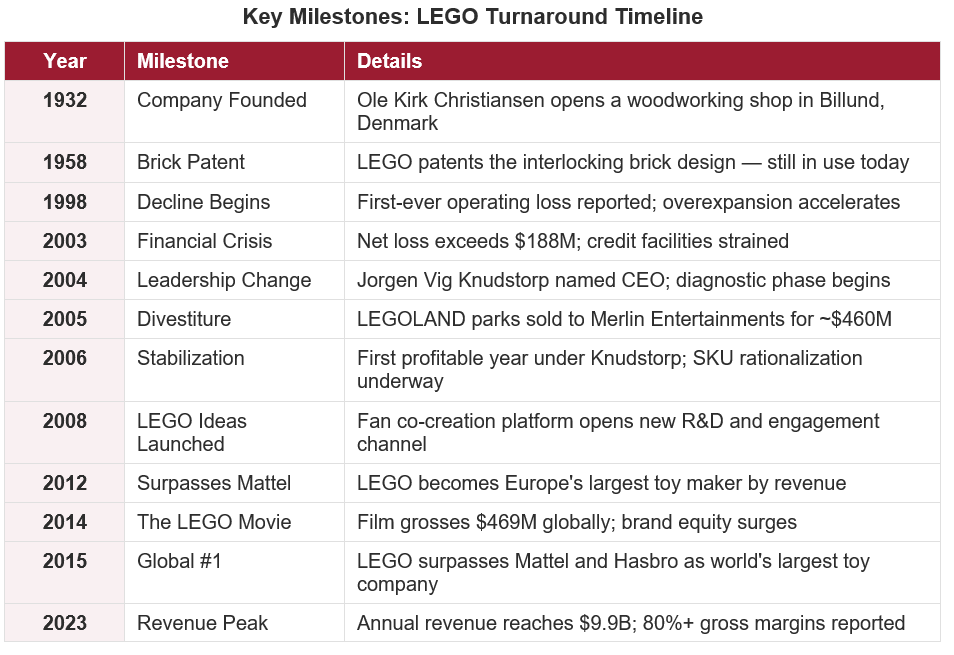
The LEGO Group stands as one of the most remarkable corporate turnaround stories of the modern era. Founded in 1932 by Ole Kirk Christiansen in Billund, Denmark, LEGO grew from a small woodworking shop to become a global toy empire — only to find itself teetering on the edge of bankruptcy in 2003 and 2004. Losses exceeded $300 million, the brand had lost its identity, and leadership had pursued reckless diversification into theme parks, clothing, and electronics.
What followed was a disciplined, decade-long resurgence anchored in a return to core values, radical simplification, and a commitment to creative partnership. By 2015, LEGO had surpassed Mattel and Hasbro to become the world’s largest toy company by revenue — a position it has maintained ever since.
This case study examines the forces that drove LEGO to the brink, the strategic decisions that reversed its decline, and the enduring lessons its turnaround holds for small and mid-size business owners today.
Company Background
Ole Kirk Christiansen founded The LEGO Group as a woodworking shop producing step stools, ironing boards, and eventually wooden toys. The company name derives from the Danish phrase “leg godt,” meaning “play well.” The iconic plastic interlocking brick — a design LEGO patented in 1958 — became the foundation of a global phenomenon.
For decades, LEGO operated with remarkable consistency. The product line was focused, the brand was trusted, and the company remained privately held by the Kristiansen family (the spelling evolved). By the mid-1990s, LEGO was generating approximately $1 billion in annual sales and employed thousands of workers worldwide.
However, the late 1990s brought significant competitive pressure. Video games, licensed entertainment products, and rapidly shifting consumer tastes challenged the company’s traditional model. Rather than doubling down on its core strength, LEGO’s leadership chose to diversify aggressively — a decision that would nearly prove fatal.

The Crisis: Overextension and Identity Loss (1998–2004)
What Went Wrong
Between 1998 and 2004, LEGO pursued a sprawling expansion strategy that diluted its identity and drained its resources. The company launched or invested in:
Theme parks (LEGOLAND) requiring massive capital investment and operational expertise far outside the company’s competencies
Clothing lines, watches, and consumer electronics with no meaningful connection to the LEGO play system
Video games and digital entertainment products that competed directly with the technology that was eroding toy sales
An explosion of product SKUs — from 6,000 unique components in the early 1990s to over 12,000 by the early 2000s
Aggressive licensing deals that produced short product life cycles and unpredictable demand
The results were catastrophic. In 2003, LEGO posted a net loss of $188 million. In 2004, losses exceeded $300 million. The company was burning through cash and had nearly exhausted its credit facilities. The Kristiansen family faced a stark choice: restructure or sell.
Root Cause Analysis
The crisis was not caused by a single misstep but by a systemic failure of strategic focus. LEGO had forgotten what made it great. Executives chased market trends rather than defining them, took on complexity the organization was not equipped to manage, and neglected the engineering-driven culture that had always distinguished the brand.
A critical contributing factor was the absence of a robust financial control system. Because LEGO was privately held and historically profitable, it lacked the rigorous cost-accounting and performance measurement infrastructure needed to detect deterioration early. By the time the crisis became visible, it was already acute.

The Turnaround: Radical Simplification and Disciplined Reinvention
Phase 1 — New Leadership and Diagnosis (2004–2005)
In 2004, the Kristiansen family appointed Jorgen Vig Knudstorp — a former McKinsey consultant who had joined LEGO in 2001 — as CEO. At just 36 years old, Knudstorp inherited a company in freefall. His first move was not a bold strategic initiative but a diagnostic one: he insisted on understanding exactly where money was being lost and why.
His findings confirmed the overextension thesis. LEGO was simultaneously underpricing its products, over-complicating its supply chain, and operating in too many unrelated business verticals. The path forward required courage: shrink to grow.
Phase 2 — The Core Three (2005–2008)
Knudstorp implemented a three-pronged stabilization strategy grounded in operational discipline:
Radical SKU Reduction: LEGO slashed its product component count from over 12,000 unique parts back toward the 6,000–7,000 range, dramatically simplifying manufacturing and logistics
Divestiture of Non-Core Assets: LEGOLAND theme parks were sold to Merlin Entertainments in 2005, freeing up capital and management attention
Supply Chain Overhaul: Manufacturing was partially outsourced and relocated closer to key consumer markets in Eastern Europe and Mexico, reducing costs while improving responsiveness
Simultaneously, Knudstorp reinvested in the LEGO brand’s core equity: the brick, the system of play, and the imagination it unlocked. Product lines were rationalized around coherent themes — LEGO City, LEGO Technic, LEGO Star Wars — that gave customers a reason to collect and build beyond a single set.
Phase 3 — Community, Co-Creation, and Culture (2008–2015)
With financial stability restored, LEGO pursued a more ambitious phase of reinvention built around an insight that proved transformational: the most passionate LEGO fans were adults, not children. The company had inadvertently ignored its most loyal constituency.
LEGO Ideas (originally LEGO Cuusoo) launched a platform allowing fans to submit original set designs for community voting. Sets that reached 10,000 votes were reviewed for commercial production, with the submitting fan receiving a percentage of royalties. This initiative generated viral engagement, reduced R&D risk, and produced some of LEGO’s best-selling sets of the decade.
The LEGO Movie (2014), produced in partnership with Warner Bros., exemplified a new entertainment strategy: instead of producing media to sell toys, LEGO created media that celebrated the brand’s values — creativity, humor, and the joy of building. The film grossed nearly $470 million worldwide and drove a significant uptick in brick sales without cannibalizing the product line.
Outcomes and Impact
The results of LEGO’s turnaround are quantitatively extraordinary and qualitatively instructive. Consider the trajectory:
Revenue grew from approximately $1.4 billion in 2004 to $9.9 billion in 2023 — a 7x increase over two decades
Operating profit margins expanded from near-zero to consistently exceeding 25% — among the highest of any consumer products company
LEGO achieved the #1 position in global toy sales, a position once considered permanently owned by Mattel and Hasbro
Brand perception transformed from “declining heritage brand” to one of the most beloved and trusted consumer brands in the world
Employee headcount grew from approximately 5,000 in 2004 to over 25,000 globally by the early 2020s
Perhaps most significantly, LEGO accomplished this without going public, without taking on excessive debt, and while remaining entirely family-owned — a testament to the power of disciplined, values-driven leadership.

Strategic Lessons for Small and Mid-Size Business Owners
LEGO’s turnaround offers a framework that transcends industry and scale. The following lessons are directly applicable to Maryland SMB owners and entrepreneurs:
1. Know Your Core and Protect It
LEGO’s diversification into theme parks and electronics was not inherently wrong — it was premature and unanchored. Every business has a core competency that drives its competitive advantage. Expansion must radiate outward from that core, not abandon it. Before pursuing a new revenue stream, ask: does this reinforce what makes us great, or does it dilute it?
2. Complexity Kills Cash Flow
LEGO’s SKU explosion was a slow-motion operational disaster. More products meant more molds, more supplier relationships, more warehouse complexity, and more unpredictable demand. Simplification freed cash and improved service levels simultaneously. For SMBs, product and service rationalization is often the highest-ROI operational lever available.
3. Your Best Customers May Not Be Who You Think
LEGO’s Adult Fans of LEGO (AFOL) community was enormous, passionate, and largely ignored until the mid-2000s. Discovering and serving a neglected customer segment drove a product renaissance. Conducting even informal customer segmentation analysis can reveal underserved constituencies generating disproportionate value.
4. Turnarounds Require Honest Diagnosis Before Action
Knudstorp’s first act was not a bold announcement — it was a rigorous assessment of where value was being destroyed. Many struggling businesses skip the diagnostic phase in favor of visible action. The willingness to face uncomfortable financial realities before acting is what separates successful turnarounds from failed ones.
5. Culture and Brand Are Durable Assets
Even at the depths of the crisis, LEGO’s brand equity remained largely intact. Customers still trusted the brick. The company’s task was not to rebuild the brand from scratch but to realign operations with the values the brand represented. For SMBs, this is a reminder that a well-built reputation is resilient — and worth protecting aggressively.
Conclusion
The LEGO Group’s recovery from near-bankruptcy to global market leadership is a case study in the power of disciplined strategic focus, operational honesty, and the willingness to simplify before you can grow. It is a story not about innovation for its own sake but about rediscovering what made a business worth building in the first place.
For small business owners navigating growth pressure, competitive disruption, or the temptation to diversify, LEGO’s journey offers a clear message: the path forward often runs directly through your core.
This is fascinating. I really enjoy reading the stories behind brands and businesses. And it's enlightening to read how LEGO changed throughout those years.